Events
Saudi National Day 2026
Read article
Saudi Arabia was named the host country for the 2034 World Cup on Dec. 11, 2024, entirely as expected. Bringing in the World Cup, the world's most watched sporting event, is a sporting victory for Saudi Arabia and the crowning achievement of its de facto ruler, Mohammed bin Salman.
The journey began in 2016, when Crown Prince Mohammed bin Salman presented his 'Vision 2030', an ambitious set of plans for Saudi Arabia's future. The program is intended to prepare the country for an era when global demand for oil will decline, and Saudi Arabia must tap other sources of income. Sports will play a key role in this.
Since then, Saudi Arabia has invested billions in both athletes and sporting events. Saudi Arabia hosts several major sporting events, including Formula 1, Formula E, UFC, LIV Golf, and the Saudi Cup. In addition, Crown Prince MBS aims to bring the 2036 Olympic Games to Saudi Arabia, following the 2034 World Cup.
Saudi Arabia paints an impressive picture of its plans, including the construction of 15 new stadiums and the creation of entirely new cities. The World Cup will mainly be held in Riyadh and Jeddah, but also in Al Khobar and Abha, with Riyadh designated as the venue for both the opening match and the final.
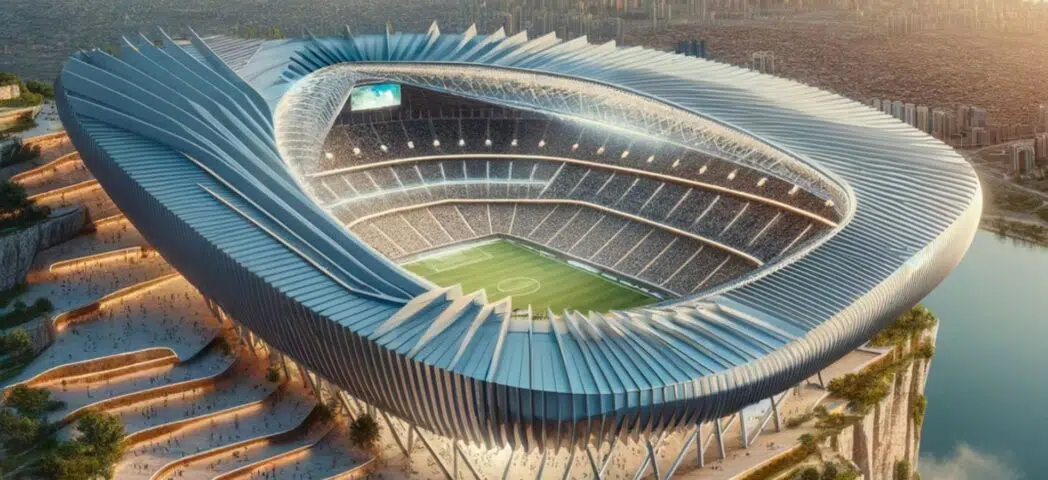
Surely the most impressive new stadium is the futuristic King Salman International Stadium, a multipurpose venue in Qiddiya City, is intended to reinforce the city's philosophy of the Power of Play. When completed, the high-tech stadium will host some of Saudi Arabia's biggest sports, entertainment and cultural events and can accommodate 92,760 spectators.
The King Salman International Stadium will be built in Qiddiya City, atop the 200-meter-high Tuwaiq cliff. Located just 40 minutes from Riyadh, it is expected to become a must-see destination in the region.
The stadium aims to attract fans and visitors from around the world and revolutionize the traditional stadium experience with its immersive futuristic design and unique technological features.
According to the Saudi news agency, the stadium will be the world's first "fully integrated" stadium with a combined retractable roof, field and LED wall. This architectural innovation offers unprecedented versatility and allows the venue to transform into different "event modes" within hours.

Following the controversy surrounding the 2022 World Cup in Qatar, where poor working conditions for migrants caused a global stir, FIFA has introduced stricter rules on human rights and worker safety. Saudi Arabia has paid extensive attention to this in its plan, focusing on sustainability and human rights in the construction of stadiums, hotels and infrastructure.
The plan also details the planned expansion of hotel capacity. Saudi Arabia reports that it already meets FIFA requirements with more than 45,000 hotel rooms in its targeted host cities. In addition, the opening of an additional 185,000 rooms is expected by 2034, a significant portion of which will focus on luxury amenities.
Saudi Arabia is also emphasizing the modernization of its airports, with all five proposed host cities to have modern airports offering connections to more than 250 international destinations. By 2030, the country plans to expand its air traffic capacity to 300 million passengers a year, spread across 16 international airports.
Here you can read more about Riyadh Air, Saudi Arabia's newest airline, which will begin operating its first commercial flights in 2026.
The climate in Saudi Arabia would be unsuitable for a soccer tournament played during the traditional period of June and July, with average daily temperatures in Riyadh and Jeddah ranging between 32 and 38 degrees Celsius, according to Saudi Arabia's own data.
A summer World Cup has never been completely ruled out until now, but it is expected that FIFA, strengthened by its experience with Qatar, will adjust the date. "We are determined to work closely with FIFA to determine the best time of year for the competition," Saudi Arabia's plans read.
However, there are complications specific to Saudi Arabia. Ramadan, the Islamic month of fasting and prayer that runs from mid-November to mid-December 2034, and the annual Hajj, during which millions of people travel to the Saudi Arabian city of Mecca , are "taken into consideration" when determining the dates for the World Cup.
That makes January 2034 the most likely date, provided the World Cup ends before the start of the Winter Olympics, which begin Feb. 10 in Salt Lake City, to satisfy the sponsors of both world events.
Starting in 2026, the number of countries participating in the World Cup will be increased from 32 to 48. The same format will also apply in 2030 and 2034, giving another 16 teams the chance to qualify.
That means a lot of action. The 12 groups of four teams ensure that we will see 72 matches before we even get to the knockout stage, with the eventual winners playing eight times.
The only team currently guaranteed to attend the World Cup is Saudi Arabia, as the host country.
It will be a long time before we know those details and much longer before tickets go on sale.
The process for the 2026 World Cup finals has yet to begin and, using the most recent World Cup in Qatar as a guide, the first phase of sales will begin 10 months before the first match. FIFA reported that 17 million ticket applications were submitted during that period, including 1.8 million for the final alone.
The 2022 event had ticket prices ranging from €75 to €230 for group matches, but FIFA did create a special category for Qatari residents, who received the cheapest tickets.
Estimating the average capacity of Saudi Arabia's 15 stadiums at about 55,000, this means that an estimated 5.7 million tickets will be available throughout the soccer tournament.
For many fans, soccer and beer are inextricably linked, especially during the world's biggest soccer event: the World Cup. But just as during the 2022 World Cup in Qatar, there will also be a strict alcohol ban in place during the 2034 tournament in Saudi Arabia—for the time being, at least. The Saudi authorities have confirmed that, for the time being, no exceptions will be made, not even in luxury hotels.
However, Saudi Arabia has quietly expanded access to its only official alcohol outlet in Riyadh, allowing non-Muslim expats with premium residency status to purchase beverages that were previously reserved exclusively for non-Muslim diplomats. This is a major change after a 73-year ban on alcohol.
The measure, which was introduced without official announcement, points to a cautious trial as the kingdom prepares for Expo 2030 in Riyadh and the FIFA World Cup in 2034, although officials deny that this is part of a broader policy change.
Get inspired and informed before visiting Saudi Arabia