Events

Saudi National Day 2026
Read article

Khaybar is one of the natural wonders located about 3 hours southeast of AlUla. A geological treasure with unforgettable scenery, Khaybar is a unique place that came about from volcanic activity in the middle of the desert. The biodiversity and rainfall bring an abundance of native plants and animals. The freshwater springs and wadis mean that many nomadic peoples consider this area their home.
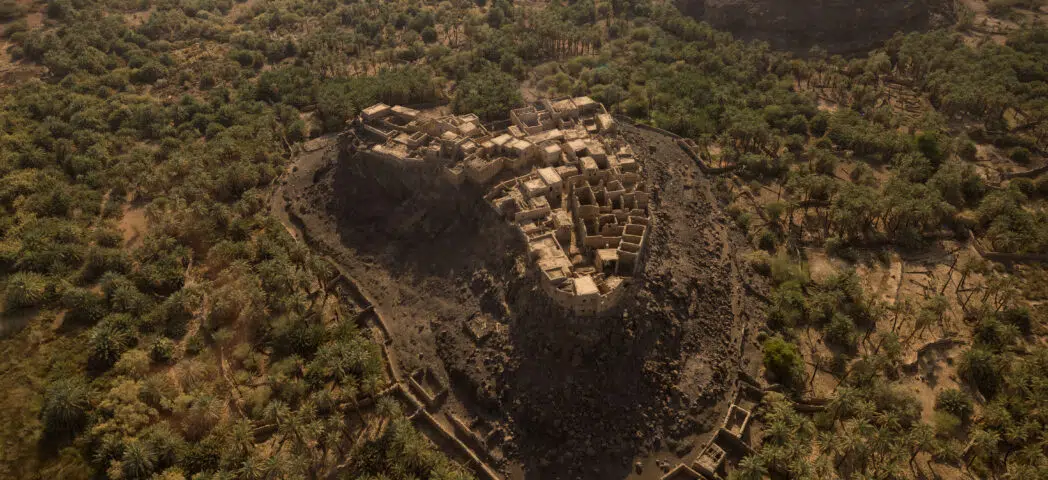
From the air, Khaybar and its surroundings look even more spectacular. Archaeology and aerial photography continuously provide new discoveries that provide a wealth of information and greatly enrich our knowledge of Arabia's early history in one fell swoop.
Like Tayma and AlUla - its sister oases - Khaybar is rediscovering its history and revealing new stories. History is layered over time, as evidenced by the remains of forts, the traditions of craftsmanship and the ways of life that still flourish here.
The ancient kingdoms of AlUla, Tayma and Khaybar highlight the importance and influence this region has played in the history of Saudi Arabia and the world.
A visit to Khaybar usually begins at the reception center, in the heart of the oasis, overlooking the village of Al-Rawan, Ain Al-Juma'a and Pebble Al-Dabal. You will be greeted by young Saudi storytellers, or Rawis, with coffee, dates and fruit. They will tell you their stories deeply rooted in the traditions, culture and heritage of northwestern Saudi Arabia.
The old center of Khaybar was inhabited until the 1980s and is now under maintenance to be opened later as an open-air museum. You cannot currently go far into the city due to renovation work, but the city can be admired from outside.
The Harrat (lava field) Khaybar Nature Reserve is an ancient volcanic landscape in one of the most spectacular locations on earth. Here, some of the earliest creations of ancient Arabia are being rediscovered on a monumental scale.
The ancient oasis of Khaybar is home to a wealth of plants and animals. Fed by fresh water, this unique bio-diverse area has played a vital role in human history for thousands of years.
Takya is a popular Saudi fusion restaurant with an establishment on top of the reception center. Scenic views of the oasis path and castles can be enjoyed from the restaurant. It serves traditional Saudi dishes with a modern twist.
The natural site of Khaybar, one of the oldest inhabited archaeological areas in the Arabian Peninsula, was formed by extinct volcanoes, which over time turned into a geological wonder.
The discovery of a 4,000-year-old village hidden in an oasis shows how life at that time slowly changed from a nomadic existence to an urban society. The remains of the city, called Al Natah, had long been hidden by Khaybar's walled oasis. An ancient 14.5-kilometer-long wall was discovered at the site. The village, with about 500 inhabitants, was built around 2400 B.C., during the early Bronze Age.
About 15 years ago, archaeologists discovered Bronze Age fortifications in the Tayma oasis, north of Khaybar. This "first essential discovery" prompted scientists to study these oases more closely. Black volcanic rocks called basalt covered the walls of Al Natah so well that it "protected the site from illegal excavation." From the air, possible paths and foundations of houses could be seen, indicating where archaeologists should dig. They discovered foundations "strong enough to support at least one- or two-story houses," but much more research is needed to fully understand the site. The preliminary findings paint the picture of a 2.6-acre town with some 50 houses on a hillside, equipped with its own wall. Tombs in a necropolis contained metal weapons such as axes and daggers, as well as gemstones such as agate, indicating a relatively advanced society. Pieces of pottery "suggest a relatively egalitarian society," according to the study. The size of the fortifications - which could be five meters high - suggests that Al Natah was the seat of a local ruler.
These discoveries show a process of "slow urbanization" during the transition from nomadic to more sedentary life. Thus, fortified oases may have interacted with each other in an area still largely inhabited by nomads. Such exchanges may even have laid the groundwork for the "frankincense route," in which spices, frankincense and myrrh were traded from southern Arabia to the Mediterranean. Al Natah was still small compared to cities in Mesopotamia or Egypt at the time.

Tayma is located between the western region of the Al-Nefud desert and the Hijaz mountain range. This oasis lies on the ancient incense trade routes that brought together civilizations mainly from Egypt, Arabia, Mesopotamia and the Mediterranean. Its history is extensive and includes the residence of the Babylonian king Nabonidus in the mid-6th century; the reason why it is also called "the land of kings.
Souq Al Najm: A 300-year-old market that still showcases the traditional crafts and culture of the inhabitants of the area.
Wall of Tayma: This 15 km long wall that once surrounded Tayma is one of the largest ancient walls in Arabia and was built between the 3rd and 4th centuries BC.
Get inspired and informed before visiting Saudi Arabia